A simple text message can become the start of a complete service journey.
Smart SMS is the clearest illustration of our approach, and the entry point most programmes start from. It is not bulk messaging. It is a two-way, conversational entry point that can carry a person from a first question to a completed service, on the phone they already own.

The development challenge
Many of the people a service most needs to reach own a basic phone, have little or no mobile data, or live where connectivity is unreliable. Services designed around apps and portals reach them last, if at all.
The access barrier
Device, cost and connectivity. A smartphone, a data bundle and a stable connection are assumed before the first question can be asked.
A person with a basic phone gets a clear answer and a next step, without an app, mobile data or a trip to an office.
Experience we build on
Smart SMS is not a concept. The conversational AI-over-SMS capability behind it is in live service today, delivered with a Botswana mobile network operator and built by Aga Intelligence on Moozy.ai.
See capability in practiceAn accessible service journey, designed with the institution that owns the service.
Automate what should be automated. Escalate what requires human judgement.
Smart SMS is one channel among several. What we deliver is the completed service journey, not the message.
Our responsible-AI principles- Two-way, conversational SMS that understands questions asked in a person’s own words.
- Answers drawn only from approved, partner-owned content.
- Structured data capture through short conversational steps, with consent.
- Routing and escalation to the right officer, service or person.
- Reminders, status updates and follow-up until the journey ends.
- Hand-over to richer channels such as WhatsApp, USSD, voice or web where they suit the person better.
Applications
- Service discovery
- Programme information
- Low-bandwidth onboarding
- Registrations
- Surveys
- Referrals
- Reminders
- Feedback
- Status notifications
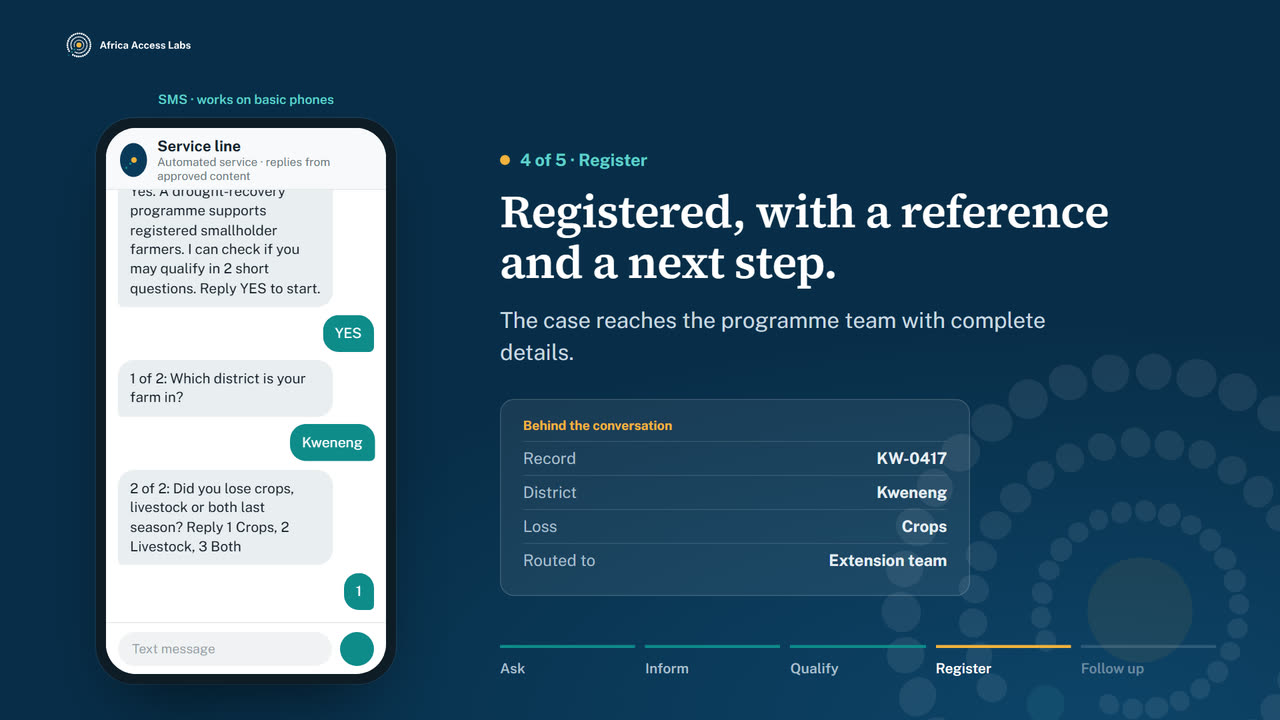
What the journey could look like.
One possible journey. Steps, rules and timelines are defined with the implementing partner.
- Asks a question by SMS
- Receives approved information
- Answers a few eligibility questions
- Registers interest and gets a reference
- Is routed to the right officer
- Receives reminders and follow-up
What institutional partners gain
Demand becomes visible, including unmet demand. Applications arrive more complete, staff time goes to cases that need judgement, and drop-off points can be seen and fixed.
Relevant channels
- SMSOur baseline channel. Works on basic phones as well as smartphones.
- USSD and voiceWhere a menu or a call suits the person better.
- WhatsApp and webRicher hand-over for people who have them.
Indicators partners could track
- Service journeys initiated and completed
- Questions resolved or routed
- Basic-phone participation
- Escalation response time
- Cost per completed journey
Design a Smart SMS programme with us.
Tell us who you need to reach, what service they need and what stands in the way. We will help you design an accessible service journey and test what works.