
Making essential services accessible to everyone.
Africa Access Labs is an African development-delivery organisation. Essential services are moving online; we help governments and development partners reach the people apps and portals leave behind, on the phones they already own.
 Built in Botswana. Designed for African service-delivery realities.

Who we are
We bridge the last mile between essential-service systems and the people those systems are intended to serve.
The question we ask
Who is currently unable to reach this service, and what stands in their way?
The principle we hold
Services should meet people through channels they can already use.
The result we work towards
More people able to understand, start and complete essential service journeys.
A service can be digital and still be out of reach.
Registrations, applications, health information, payments, advisory services and assistance programmes are moving onto portals, apps, digital forms and messaging channels. The gains are real. But digital transformation does not automatically mean digital inclusion.
Each design choice quietly sets a threshold for participation. Each threshold is modest. Together they decide who gets through. This is an access-design problem, not a deficit in communities.
People should not have to become sophisticated digital users before they can access essential services.
From communication to service delivery.
Communication is only the beginning. Select a stage to see what changes for the person and for the institution.
Stages 1 to 3 are where a messaging service usually stops. Stages 4 to 9 are where the service journey continues, through to a measured outcome.
-
Reach
For the personIs contacted through a channel they already use.
For the institutionReach extends beyond app and web users.
-
Inform
For the personReceives trusted, plain-language information.
For the institutionConsistent messaging from approved content.
-
Engage
For the personAsks questions in their own words and language.
For the institutionReal questions and needs become visible.
-
Understand need
For the personIs understood, not pushed through a script.
For the institutionEach person is matched to the right service.
-
Capture information
For the personShares only the details the service needs, with consent.
For the institutionComplete, usable data enters programme systems.
-
Qualify or route
For the personIs directed to the service or person who can help.
For the institutionPartner rules are applied consistently.
-
Serve, refer or escalate
For the personCompletes the service, or reaches a qualified person.
For the institutionStaff time goes to cases that need judgement.
-
Follow up
For the personReceives reminders, updates and support until the journey ends.
For the institutionCompletion improves, and drop-off points are known.
-
Measure outcome
For the personCan say what happened and give feedback.
For the institutionEvidence for learning, reporting and scale.
We do not measure success by messages sent. We design for completed service journeys and measurable outcomes.
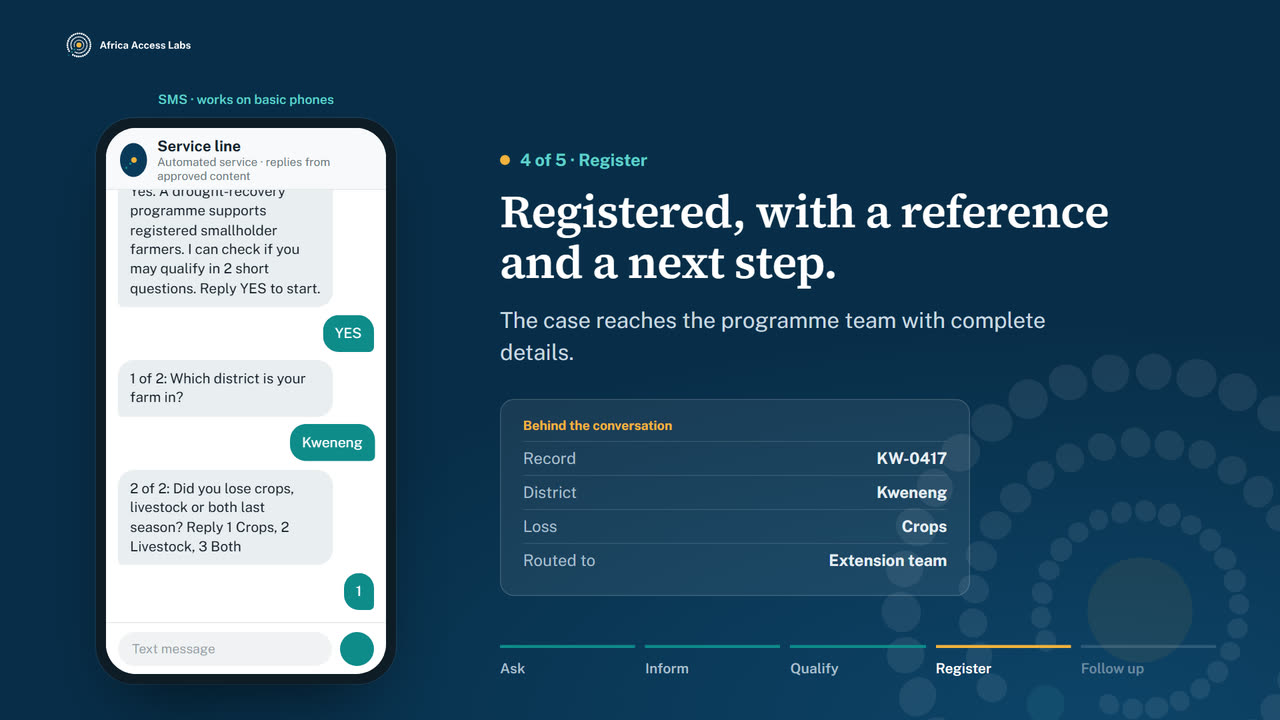
A simple text message can become the start of a complete service journey.
A journey on a basic phone: a question, a clear answer, a few eligibility questions, a reference number and follow-up.
Built on demonstrated low-bandwidth capability.
Two services built by Aga Intelligence on Moozy.ai shaped our model: a live Smart SMS service delivered with a Botswana mobile network operator, and an intent-aware SMS insurance journey developed for a Botswana insurance provider. Both work over SMS, on basic phones as well as smartphones.
See capability in practiceSix programme areas on one access infrastructure.
Each area applies the same access model to a different essential service, with content, rules and escalation paths owned by the sector partner.
- Smart SMS
A two-way, conversational entry point to information and services, on any phone that can send a text.
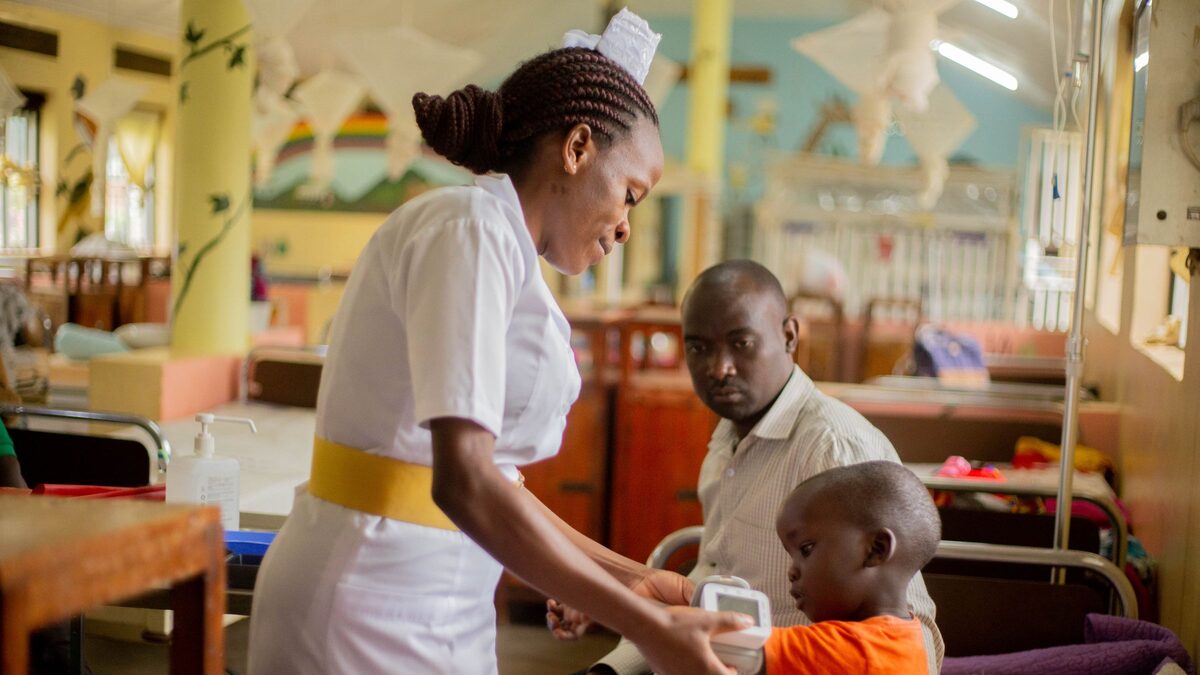
- Digital Health
Continuity of care between visits, alongside the health workers who provide it.
- Citizen Services
Government and public services that are easier to find, understand and complete.

- Financial Inclusion
Helping people understand, access and confidently use appropriate financial services.

- Agriculture & Climate
Smallholder livelihoods and climate resilience through timely, accessible information.

- Humanitarian Engagement
Responsible communication, accountability and access to assistance for affected populations.

Built to work inside programmes led by others.
We bring inclusive digital-delivery capability into programmes led by institutions with the mandate, expertise and trust to deliver development outcomes. We never replace sector experts or accountable institutions.
How partnerships work- Development partners and funders
- A delivery partner that keeps demonstrated and proposed capability visibly apart, agrees indicators at design stage and reports contribution, not attribution.
- Governments and public institutions
- Keeping public services accessible as they become increasingly digital.
- Implementing organisations
- Engagement, onboarding, data capture, referral and follow-up for programmes already in delivery.
- NGOs and civil society
- Communicating with, understanding and serving communities more effectively.
- Consortiums
- The digital-access, engagement and data component of larger funded programmes.
- Research and evaluation partners
- Structured data on who is reached, what happens in the journey and where people drop out.
- Sector specialists
- Working alongside clinicians, agronomists, financial institutions, humanitarian professionals and social workers.
Validate locally. Adapt with local partners. Scale responsibly.
Access for people can be free or subsidised while the infrastructure stays financially sustainable through institutional and programme funding.
- Co-designAgree the excluded group, the service journey and the indicators with partners.
- PilotTest the journey with real users, under a defined learning agenda.
- EvidenceMeasure reach, completion and outcomes against a baseline.
- Institutional adoptionHand the validated service to the institution that owns it.
- ReplicationAdapt what works, with local partners, in new settings.
If we cannot show what changed, we have not finished the job.
We keep reach, output, outcome and impact clearly separate, agree indicators with partners at design stage, and distinguish our contribution from the wider programme’s results.
Our measurement approachReach
Who did we contact?
Output
What did the service deliver?
Outcome
What changed for people or the programme?
Impact
What longer-term change did the wider programme contribute to?
Developed and proven in Botswana, for settings across the continent.
Botswana is our home base, where our capability is developed, and a useful proving ground for inclusive service delivery. The barriers we design around are shared across much of the continent: basic phones, rationed data, long distances, many languages, uneven connectivity and fragmented service systems.
About Africa Access LabsWhat stands between people and the service you need them to reach?
We work with governments, development partners and implementing organisations to identify that gap, design an accessible service journey and test what works.
We reply by email and add no one to a mailing list.