
For people affected by crisis: accurate information and a safe way to be heard.
People affected by crisis need to know what assistance exists, who qualifies and where to go, and they need a safe way to raise concerns. Africa Access Labs works in humanitarian settings alongside experienced humanitarian organisations and responsible institutions.

The development challenge
Information about assistance can be inconsistent or hard to reach, and people need a channel they trust to give feedback or report a concern.
The access barrier
Uncertainty about eligibility and distributions, limited channels for feedback, and the risk that sensitive concerns are not heard by the right people.
People know what support is available and how to reach it, and their feedback reaches someone accountable.
An accessible service journey, designed with the institution that owns the service.
Automate what should be automated. Escalate what requires human judgement.
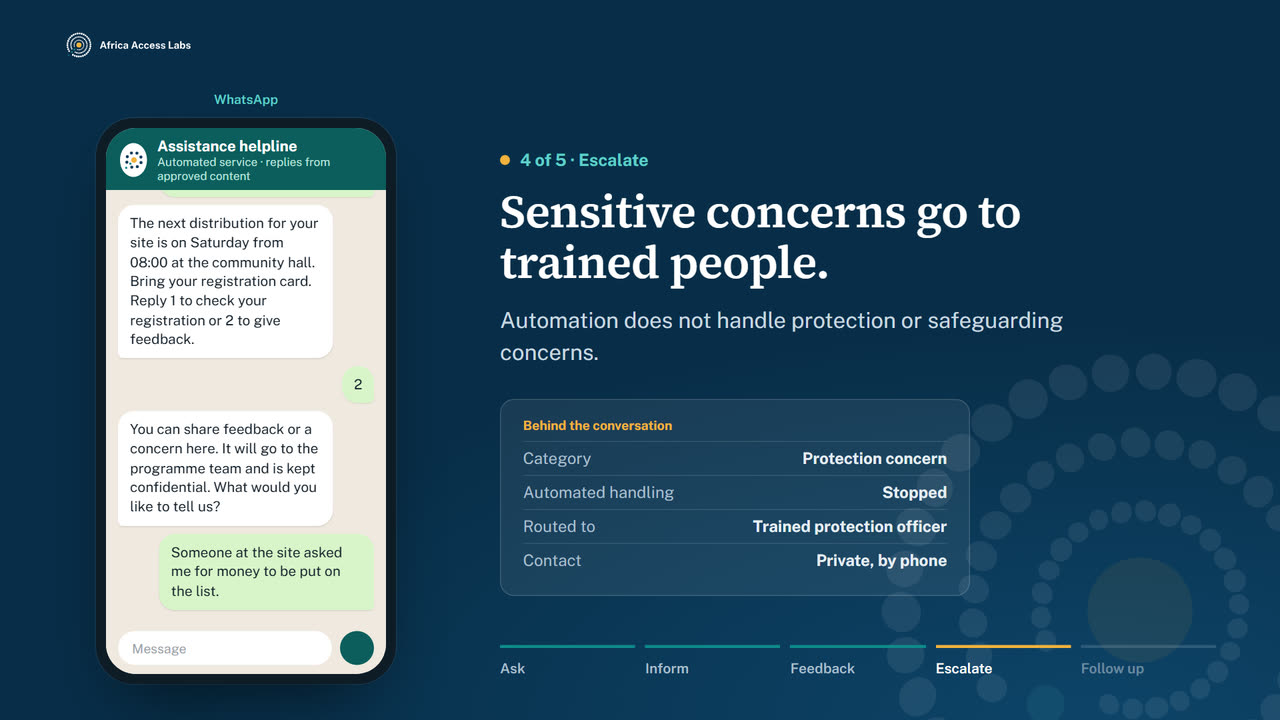
We work alongside experienced humanitarian organisations, inside their accountability and protection frameworks. Protection and safeguarding concerns always escalate to trained people.
Our responsible-AI principles- Programme information and two-way communication with affected people through familiar channels.
- Registration, needs assessments and surveys, with data minimisation.
- Distribution notifications and service navigation.
- Feedback and complaints mechanisms.
- Case escalation of protection and safeguarding concerns to trained staff.
Applications
- Programme information
- Communication with affected people
- Registration
- Distribution notifications
- Referrals
- Needs assessments
- Feedback
- Complaints
- Service navigation
- Case escalation
What the journey could look like.
One possible journey. Steps, rules and timelines are defined with the implementing partner.
- Asks about assistance
- Receives programme information
- Chooses to give feedback
- Raises a sensitive concern
- Concern escalates to trained staff
- Is contacted privately
What institutional partners gain
Clear, consistent communication with affected people, a working feedback loop, and sensitive concerns routed to trained staff.
Relevant channels
- SMSInformation and notifications on any phone.
- WhatsAppTwo-way feedback where people have it.
- Voice and human contactFor sensitive conversations.
Indicators partners could track
- People informed ahead of distributions
- Feedback and complaints received and closed
- Response time
- Language coverage
- Escalations handled within agreed time
Other programme areas
Design a Humanitarian Engagement programme with us.
Tell us who you need to reach, what service they need and what stands in the way. We will help you design an accessible service journey and test what works.